Physics 101 - Homework # 2 Solutions
Note: Symbols written in Bold are vectors.
Chapter 1
Problem 50)
-
a) A + B + C + D =
(-2i - 3j) +
(i + 2j + 3k) + (3j + 3k)
+ (-2i -k)
- =
- 3i + 2j + 5k
- b)
A - D = (-2i - 3j) -
(-2i -k)
= -3j + k
- c)
A + D - B = (-2i - 3j) +
(-2i -k) - (i + 2j + 3k) =
- 5i - 5j -4k
-
d) A - C = (-2i -3j) -
(3j + 3k)
= -2i - 6j -3k
- |A - C| = [(-2)2 + (-6)2 +
(-3)2]1/2 = 7
Chapter 3
Problem 2)
-
Given r = (c1 - c2t)i + (d1
+ d2t + d3t2)j
-
= [(12 m) - 3 m/s)t]i + [(-20 m) + (-3 m/s)t +
(0.5 m/s2)t2]j
- To find the time to pass through x=0 we solve the
x-component equation:
-
x = 0 = (12 m) - (3 m/s)t to get
t=4 s
- Setting x = y gives us:
- (12 m) - ( 3 m/s)t = (-20 m) - (3 m/s)t + (0.5 m/s2)t2
- 0 = 32 m - (0.5 m/s2)t2
- t2 = 64 s2
- from which we get t = ± 8 s
- To find the locations, we substitute these values into the expression for
r:
- t = - 8 s:
r = (36i + 36j) m
- t = + 8 s:
r = (-12i - 12j) m
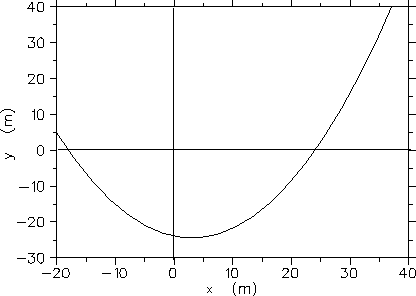
Plotting y vs. x we have:
Problem 13)
- From the definition of instantaneous acceleration, we have
-
a = dv/dt = d(2.2 m/s i + 3.7 m/s2t j +
[(3.3 m/s) - 1.2 m/s3)t2]k]/dt
-
- we differentiate each component separately, and then add them:
- = (3.7 m/s2)j - (2.4 m/s3)t
k
- Note: the textbook has a typo in the solution in the back; it
has - (2.4 m/s2)t for the second term, which is not correct dimensionally.
Problem 20)
- We are given v0 = ( 50 m/s)j and
a = [35 m/s2 + (2 m/s5)t3]i
+ [4 m/s2 - (1 m/s4)t2]j
- To find the velocity, we need to integrate this with respect to time;
- v =
 a dt
a dt
- which gives
- v - v0 =
[(35 m/s2)t + (2 m/s5)t4/4]i
+ [(4 m/s2)t - (1 m/s4)t3/3]j
- or
- v = [(35 m/s2)t + (0.5 m/s5)t4]i
+ [ 50 m/s + (4 m/s2)t - (1 m/s4)t3/3]j
- To find the position, we must integrate again :
- r = v dt
- This gives
- r = [(35 m/s2)t2/2 +
(0.5 m/s5)t5/5]i
+ [(50 m/s2)t + (4 m/s2)t2/2 -
(1 m/s4)t4/12]j
- substituting t= 3 s into the above expressions for v and r, we have
- v = (146 m/s)i + (53 m/s)j
- r = (182 m)i + (161 m)j
Problem 30)
- First choose a coordinate system: x is horizontal, y is vertical,
and the origin is the base of the building.
- a) Use the vertical motion to get the time of flight:
- y = y0 + v0yt + (1/2)ayt2
- Here we have y=0 (when it hits the ground), an initial height of
y0 = 10 m, v0y = 0 and ay = = -9.8 m/s2,
so
- 0 = 10m + 0 + (1/2)(-9.8 m/s2)t2
- Solving for t we get
- t = 1.43 s
- Now we substitute this time into the horizontal position equation
- x = x0 + v0xt
- (there is no acceleration in the x-direction), or
- 8.0 m = 0 + v0x(1.43 s)
- thus
- v0x = 5.6 m/s
- b) If the ball is thrown up at an angle, the initial velocity will
need to change; now,
- y = y0 + v0yt + (1/2)ayt2
- becomes
- 0 = 10m + v0(sin29°)t + (1/2)(-9.8 m/s2)t2
- and the x equation becomes
- x = v0xt
- 8.0 m = v0(cos29°)t
- These are two equations in two unknowns, so we can solve them. Solving
the second equation for v0 in terms of t, and sticking this in the
first equation gives
- 0 = 10m + (8.0 m)/cot(29°) + (1/2)(-9.8 m/s2)t2
- solving this for t gives
- t = 1.7 s
- and plugging this back into the second equation gives
- v0 = 5.4 m/s
- c) from above, t = 1.7 s
Problem 36)
-
We will use a coordinate system with the origin at the base of the tower,
x=horizontal, and y=vertical, so y0 = H where H
is the tower's height.
- a) For the horizontal motion:
- x = v0xt = v0cos45°t
- 20 m = v0(0.707)(4 s) which gives
- v0 = 7.1 m/s
- b) For the vertical motion:
- y = y0 + voyt + ½ayt2
- 0 = H + (7.1 m/s)(cos 45°) + ½(-9.8 m/s2(4 s)2
- which gives
- H = 58 m
- c) To find the components of the velocity:
- vx = v0x = (7.1 m/s)cos45° = 5.0 m/s
- and
- vy = v0y + ayt
- = (7.1 m/s)(sin45° + (-9.8 m/s2)(4 s) = -34 m/s
- The speed is the magnitude of the velocity:
- v = (vx2 + vy2)1/2
[(5.0 m/s)2 + (-34 m/s)2]1/2 =
34.4 m/s
Problem 43)
- The radius of the circular path is R = REarth + h
- =
(6.37 x 10³ km) + 220 km = 6.59 x 10³ km
-
a) The speed is v = 2
 R/T
R/T - =
2(6.59 x 10⁶ m)/(89 min)(60 s/min) =
7.8 x 10³ m/s = 28 x 103 km/h
- b) The acceleration is a = v2/
R
- = (7.8 x 10³ m/s)2/(6.59 x 106 m)
= 9.1 m/s2 toward the earth's center.
- Aside: this is suspiciously close to "g", but not exactly the same -
we will see why in Chapt. 12.
Problem 48)
-
The velocity of a point on the rim of the flywheel is just
given by
- v =
(4000 rev/min)(2(0.10 m)/rev)(1 min/60 s)
- = 41.9 m/s
- since each revolution is a path length of
2r.
The centripetal acceleration is
- a = v2/r
- = (41.9 m/s)2/(0.10 m) = 1.75 x 10⁴ m/s2
= 1790 g
- since g= 9.8 m/s2.
Problem 55)
- This is a relative velocity problem. If we use a coordinate system with x east and y north, the velocity of the
boat with respect to the water is
- vB = vA - u, where
- vA = 15 i km/h
is the velocity of the
boat with respect to the land and
- u = 5 j km/h is the velocity of the Gulf Stream
with respect to the land.
- Thus
- vB = (15i - 5j) km/h =
15.8 km/h, 18.4° south of east.
-
Problem 60)
- a) Another relative velocity problem.
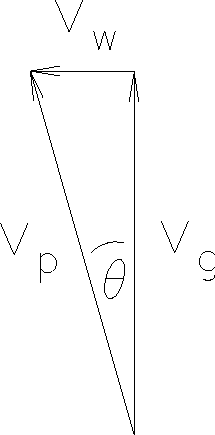 In order to fly due north, the airplane must head northwest (to
counterbalance the wind) as shown in the diagram. Let vp
be the velocity of the plane with respect to the air,
vg be the velocity of the plane with respect to the
ground, and vW the velocity of the wind with respect
to the ground. Then
In order to fly due north, the airplane must head northwest (to
counterbalance the wind) as shown in the diagram. Let vp
be the velocity of the plane with respect to the air,
vg be the velocity of the plane with respect to the
ground, and vW the velocity of the wind with respect
to the ground. Then
- vg = vp + vW
- The heading angle (see diagram) is given by
- sin
 = vw/vp
= (65 mi/h)/(180 mi/h)
= vw/vp
= (65 mi/h)/(180 mi/h)
- which gives
- =
21.2° west of north.
- Because the diagram we used to find the angle was a velocity diagram,
it is independent of distances, so the angle would be the same regardless
of the distance.
- b) Again, from the diagram, we have
- vg = vpcos
= (180 mi/h)cos21.2° = 168 mi/h
- thus the time of flight is
- t = d/vg = (673 mi)/(168 mi/h) = 4.0 h
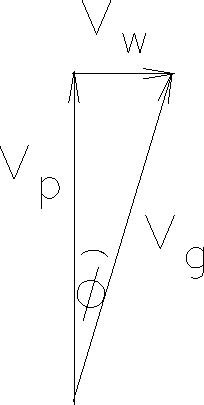
- c) If the airplane heads north until it reaches the latitude of
St. Louis, its velocity with respect to the ground will be to the
northeast, as shown in the diagram.
- The time for the first leg of the trip (before the plane turns west)
can be found from
- t1 = 673 mi/(180 mi/h) = 3.74 h
- The plane must then travel towards the east a distance
- d = vWt1 = (65 mi/h)(3.74 h) = 243 mi
- since this is the distance the wind blew the plane westwards. As it
goes west, its speed with respect to the ground is given by
- vnew = vp - vW
= 180 mi/h - 65 mi/h = 115 mi/h
- Thus the time required is
- t2 = 243 mi/(115 mi/h) = 2.11 h
- The total time for the trip is then
-
- t1 + t2 =
3.74 h + 2.11 h = 5.85 h
- which is substantially longer than using the flight plan in part a).
Physics
101 Solutions
Physics 101 Home page
Physics Department Home Page
College of William and Mary,
Dept. of Physics
armd@physics.wm.edu
last updated: Sept. 1 2000