Physics 101 - Homework # 4 Solutions
Note: Symbols written in Bold are vectors.
Chapter 5
Problem 6)
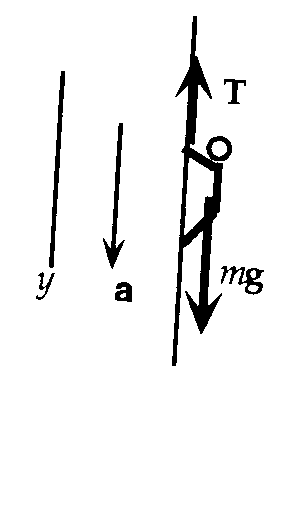
The tension in the rope is created by the contact between the rope
and the man's hands. The man will pull down on the rope, and the rope will
pull up on the man. As shown in the figure, we take down to be the positive
direction (this is the direction of the acceleration).
- a) For the man we can write
 Fy = may
mg - T = ma - From this we see that there is a minimum acceleration that produces
the maximum tension:
- (85 kg)(9.8 m/s2) - 700 N = (85 kg)amin
- which gives
- amin = 1.56 m/s2
- b) For this constant acceleration, we can write
- y = y0 + v0t + ½at2
- = 0 + 0 + ½(1.6 m/s2)(4.0 s)2
- = 12.5 m
- To find the velocity, we use
- v = v0 + at = 0 + (1.6 m/s2)(4.0 s) =
6.24
m/s down.
Problem 10)
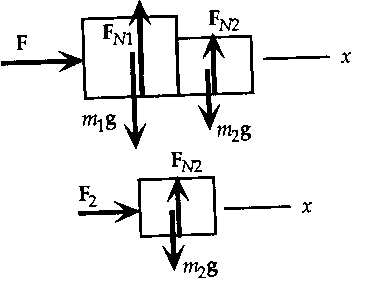
- F = (m1 + m2)a which gives
- a = F/(m1 + m2)
- b) Choosing the block on the right as the system now, then
F = ma gives, for the
x-component,
- F2= m2a =
m2F/(m1 + m2)
- Note that an equal and opposite force acts on m1.
Problem 14)
-
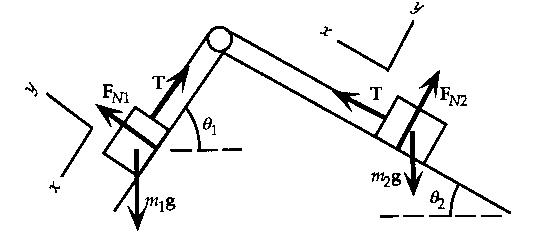
There are two different coodinate systems used, one for each
of the blocks. Since the string doesn't stretch, the tension is the same
at each end of the string.
- Now write
F = ma for each
block, using the force diagrams:
- Block 1, x-component: m1g sin
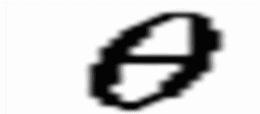 1 - T = 0
-
Block 2, x-component: T - m2g sin2 = 0
- since we require the acceleration to be 0. Note that we don't need
the y-component equations here. Adding the
two equations together, to eliminate T, we get
- m1g sin1
= m2g sin2
- Plugging in numbers we get
- (1.50 kg)sin62° =
(2.50 kg)sin2
- which gives
- 2 =
32°
Problem 20)
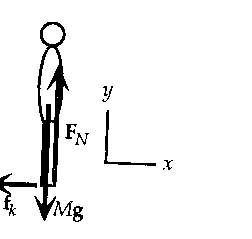
- The acceleration can be found from the boy's one-dimensional motion:
- v = v0 + at
- 0 = 4.5 m/s + a(3.4 s)
- which gives
- a = - 1.32 m/s2
- Using the force diagram for the boy, we can write F
= m a
- x-component: - µkFN = Ma
- y-component: FN - Mg = 0
- Thus
- FN = Mg
- and
- µk = - a/g
- = - (-1.32 m/s2)/(9.8 m/s2) = 0.135
Problem 28)
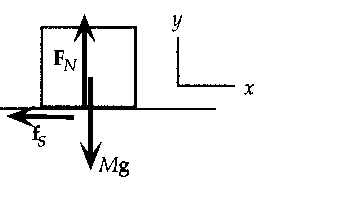
- Static friction must be backward, to oppose the impending slide along
the truck bed and provide the deceleration of the crate. We can find the
acceleration from the motion of the truck:
- v2 = v02 + 2a(x-x0)
- 0 = (26.7 m/s)2 + 2a(140 m -0)
- which gives
- a = - 2.55 m/s2
- We write F =
ma from the force diagram for the crate:
- x-component: -fs = ma
- y-component: FN - Mg = 0
- Thus
- fs = -ma = -(250 kg)(-2.6 m/s2) = 638 N
- and
- FN = Mg = (250 kg)(9.8 m/s2) = 2450 N
- Because fs = fs,max = µsFN
the minimum µ required is
- µs,min = fs/FN = (638 N)/(2450
N) = 0.26
Problem 32)
-
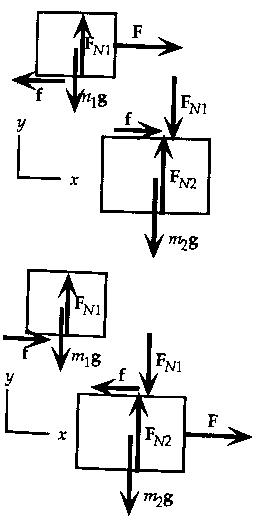
The two blocks must have the same acceleration; we apply
F = ma for the
force diagram for the upper block:
-
x-component: F - f = m1a
-
y-component: FN1 - m1g = 0
Writing F = ma
for the lower block:
-
x-component: f = m2a
-
y-component: FN2 - FN1 -
m2g = 0
- From the y-component equations we have
-
FN1 = m1g and
FN2 = (m1+m2)g
- We can eliminate a from the two x-equations, to get
- F = (m1 + m2)f/m2
- The maximum value of F is therefore when f is at its maximum
value, which is
- fmax = µsFN1
= µsm1g
- Thus
- Fmax = (1.2 kg + 1.8 kg)[0.3(1.g kg)(9.8 m/s2]/(1.8 kg)
- = 5.9 N
- If the force F is applied to the lower block, the x-equations now become
- top block: f = m1a
- bottom block: F - f = m2a
- We can eliminate a from these equations, to yield
-
F = (m1 + m2)f/m1
- so the maximum value of F becomes
- Fmax = (1.2 kg + 1.8 kg)[0.3(1.g kg)(9.8 m/s2]/(1.2 kg)
- = 8.8 N
Problem 36)
- At terminal velocity, a = 0 (by definition!), and the weight is balanced
by the drag force:
- Fdrag = mg = kv2
- so
- k = mg/v2 = 116 kg(9.8 m/s2)/(4.9 m/s2) =
4.7 Ns2/m2 = 4.7 kg/m
Problem 46)
- The centripetal acceleration is
- ar = v2/r = (200 m/s)2/(30 x 103 m)
=
1.3 m/s2 toward the center
Problem 49)
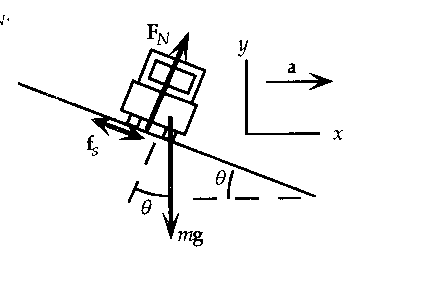
- If the automobile does not skid, the friction is static, with fs
<= µsFN. At high speed fs will
be down the incline. Note that we take a coordinate system with
the x-axis in the direction of the centripetal acceleration.
- We write F = ma
from the force diagram for the car :
- x-component: fNsin
+ fscos = ma = mv2/R
- y-component: FNcos
- fssin - mg = 0
- The speed is maximum when fs = fs,max
= µsN
- From the y-equation we get:
- FNcos - µsFNsin
= mg
- or
- FN = mg/(cos - µssin)
- Plugging this into the x-equation leads to:
- vmax2/R = g(sin
+ µscos)/(cos
- µµsin)
- vmax2 = (150 m)(9.8 m/s2)(sin18°
+ 0.3cos18°)/(cos18° - 0.3sin18°)
- which gives
- vmax = 32 m/s
At low speed, the automobile will tend to slide down the incline,
so fs will be up the slope. The speed is minimum when
fs = fs,max = µsFN
If we change the sign of fs in the equations, we get
FN = mg/(cos + µs
sin)
and
vmin2/R = g(sin
- µscos)/(cos
- µssin)
Thus
vmin2 = (150 m)(9.8 m/s2)(sin18°
- 0.3 cos18°)/(cos18° + 0.3 sin18°)
which gives vmin = 5.8
m/s
Chapter 6
Problem 5)
- The work done on the crate increases its kinetic energy:
- W =
 K = ½mv2
- ½mv02
K = ½mv2
- ½mv02
- = ½(66 kg)[(63 km/h)(103 m/km)/(3600 s/h)]2
- 0 = 1.01 x 10⁴ J
Another way to solve this would be to use W = Fx,
and use kinematics to work out what x
is.
Problem 6)
- a) Because the workmen do not provide a force through a distance,
W = 0 (of course we are not
considering the work done in pushing the piano to the window from wherever
it was in the apartment!)
- b) If the piano is slowly lowered, this means that the acceleration
is very close to 0, so the tension has the same magnitude as the gravitational
force:
- WT = - T x = -
(mg)x = - (120 kg)(9.8 m/s2)(30
m) = - 3.53 x 10⁴ J
- c) Wg = (mg)x =
+ 3.53 x 10⁴ J (equal and opposite
to the work done by the tension)
Problem 45)
-
The work is done by two forces, the tension in the rope (provided by
the movers) and gravity. Gravity is a conservative force, so the work done
by gravity is independent of the path, and so it is the same for both
paths. The net work is zero (since there is no change in kinetic energy!),
and therefore the work done by the tension in the rope must also be
the same for both paths:
- Wnet = 0 = WT + Wg
- WT = - Wg = -mg(-H) =
(54 kg)(9.8 m/s2)(4.0 m) =
2.1 x 10³ J
- However, despite the fact that the work done by the movers
is the same in both cases, they have to exert a smaller force (albeit over
a larger distance) when they pull it up the incline, so they will likely
consider that the easier way to go.
Problem 83)
- a) The tension in the rope is always perpendicular to the
direction of motion, thus it does no work: WT
= 0
- b) Since the normal force (N) balances the puck's weight (mg), we have
a frictional force
- fk = µkN = µkmg
- The frictional force is opposite to the direction of motion, and
therefore is tangential to the path. The work done by friction is then
- Wf = µkmg(2
 r)
r)
- = -0.02(0.2 kg)(9.8 m/s2)(2)(0.8 m) = -0.20 J
- The net work is equal to the change in kinetic energy, so
- W = K
- -0.20 J = Kf - (1/2)(0.2 kg)(10 m/s)2
- which gives Kf = 9.8 J
Physics
101 Solutions
Physics
101 Home page
Physics Department Home
Page
College of William and Mary,
Dept. of Physics
armd@physics.wm.edu
last updated: Oct. 9 2000