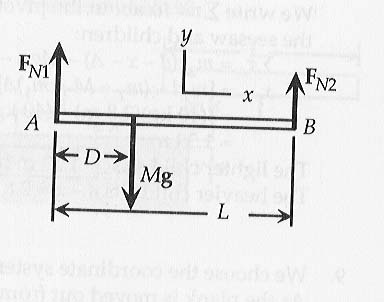
 We choose the coordinate system shown, with positive torques chosen to be
clockwise. Let's write
We choose the coordinate system shown, with positive torques chosen to be
clockwise. Let's write 
 = I
= I about the point A from the
force diagram for the board:
A = MgD - FN2L = 0 Fy = may
from the force diagram for the board and worker:
We choose the coordinate system shown, with positive torques chosen to be
clockwise. Let's write = I about the point A from the
force diagram for the board:
A = MgD - FN2L = 0 Fy = may
from the force diagram for the board and worker:
about the point A from the
force diagram for the board:
A = MgD - FN2L = 0 Fy = may
from the force diagram for the board and worker:
We choose the coordinate system shown, with positive torques chosen to be
clockwise. Let's write = I about the point A from the
force diagram for the board:
A = MgD - FN2L = 0 Fy = may
from the force diagram for the board and worker: 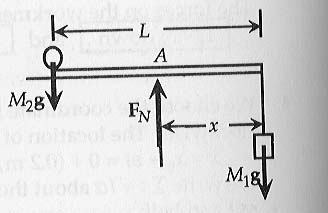 We choose the coordinate system shown, with positive torques clockwise.
As the plank is moved out from the roof the effective normal forces acts
at a point closer to the edge. When the normal force reaches the edge,
the plank is on the verge of tipping. We write = I
about the edge A from the force diagram for the plank, the load and the
concrete:
A = M1gx - M2g(L-x) =0
We choose the coordinate system shown, with positive torques clockwise.
As the plank is moved out from the roof the effective normal forces acts
at a point closer to the edge. When the normal force reaches the edge,
the plank is on the verge of tipping. We write = I
about the edge A from the force diagram for the plank, the load and the
concrete:
A = M1gx - M2g(L-x) =0 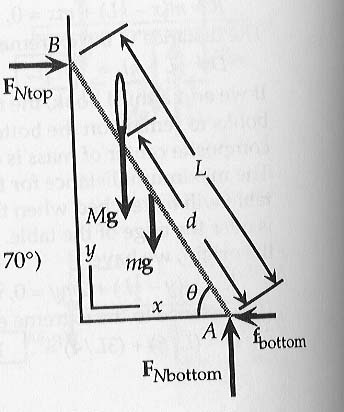
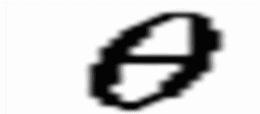 = h/L = (8 m)/(8.5 m) = 70.2° = I about the point A from the force diagram
for the ladder and man:A = mg(½L)cos + Mgdcos
- FNtopLsin = 0 /(L sin) Fx = max from the
force diagram for the ladder and man: Fy = may the force diagram for
the ladder and man gives
= h/L = (8 m)/(8.5 m) = 70.2° = I about the point A from the force diagram
for the ladder and man:A = mg(½L)cos + Mgdcos
- FNtopLsin = 0 /(L sin) Fx = max from the
force diagram for the ladder and man: Fy = may the force diagram for
the ladder and man gives 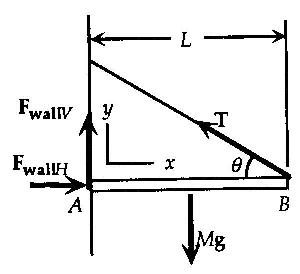 =
I about the point A as:
A =
Mg(L/2) - (Tsin)L = 0 ) Fx =
max using the force diagram to get = 0 Fy =
may we have - Mg = 0
=
I about the point A as:
A =
Mg(L/2) - (Tsin)L = 0 ) Fx =
max using the force diagram to get = 0 Fy =
may we have - Mg = 0 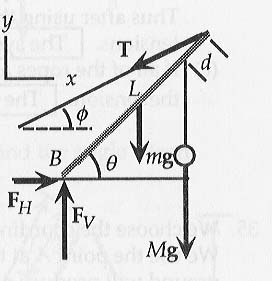 =
I about the point
B from the force diagram for the beam: B = mg(½Lcos) + Mg(L-d)sin
- Tcos
=
I about the point
B from the force diagram for the beam: B = mg(½Lcos) + Mg(L-d)sin
- Tcos (Lsin) - Tsin(Lcos) = 0 ) and its y-component
(-Tsin), and seen that the
lever arm for the x-component is Lsin
and that for the y-component is Lcos.
Solving this for M gives sin -sincos)/g] - ½mLcos}/[(L-d)sin]
(Lsin) - Tsin(Lcos) = 0 ) and its y-component
(-Tsin), and seen that the
lever arm for the x-component is Lsin
and that for the y-component is Lcos.
Solving this for M gives sin -sincos)/g] - ½mLcos}/[(L-d)sin]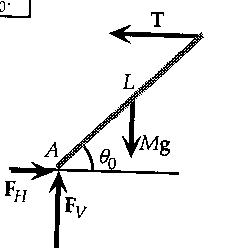
We choose the coordinate system shown. Choose counterclockwise for the direction of positive torques.
=
I about the point A, using the force diagram
for the beam:
A = Mg(L/2)cos
- TLsin = 0
A = I =
(1/3)ML2
= (3gcos)/2L , or,
it is easier to use energy considerations. Since the force at the pivot does no work
on the beam, only gravity does work, and we have  K + U
K + U  2-0] +
Mg[0 - (L/2)sin] =
[(3gsin)/L]1/2
2-0] +
Mg[0 - (L/2)sin] =
[(3gsin)/L]1/2
 2R3/GM 2(2.04 x 10⁶ m)3/
(6.67 x 10⁻¹¹ Nm2/kg2)(7.35 x 1022 kg) 2 = g 2 = 0.40 rad/s
F/r = dF/dr = -2GMm/r3 = - 2mg/r F = - 2mgr/r = -2(1 x 10⁻³
kg)(2.67 x 10¹² m/s2)(1 x
10-2)/(10 x 103)
2R3/GM 2(2.04 x 10⁶ m)3/
(6.67 x 10⁻¹¹ Nm2/kg2)(7.35 x 1022 kg) 2 = g 2 = 0.40 rad/s
F/r = dF/dr = -2GMm/r3 = - 2mg/r F = - 2mgr/r = -2(1 x 10⁻³
kg)(2.67 x 10¹² m/s2)(1 x
10-2)/(10 x 103)